Patient guide · Planning
Medical Care in China for Foreigners: Medical Tourism and Healthcare
China has 38,710 hospitals, among them 1,876 rated Grade III, Class A — the top tier. ChinaMedMap matches international patients with licensed hospitals whose identity we confirm from official sources, based on their medical needs and drawing on sourced, dated hospital profiles. A real team member reviews every inquiry personally and offers information and matching — not diagnosis or a guarantee of acceptance.

Quick answer. Foreigners can receive treatment in China. Gather complete medical records, choose a hospital whose department and international services fit your case, confirm the visa — usually an S2 backed by the hospital's certificate — and plan to pay out of pocket or through international insurance.[3],[6]
What Should Foreigners Know Before Seeking Care in China?
Preparation, not luck, determines whether medical care in China for foreigners goes smoothly. A widening pool of international travelers now chooses China over home-country systems, mainly to sidestep long waiting lists or steep bills. That shift changes what newcomers need to know before booking a flight or a first appointment.
Speed draws many patients first. Care in China is hospital-based: patients register directly with a hospital department, without waiting for a family-doctor referral. That pace surprises people used to multi-week referral chains. It does not, however, mean every hospital or department operates the same way.
Can any foreigner walk into any Chinese hospital?
Foreigners can receive treatment in China, but fit matters more than access. Not every hospital, department, insurer, or travel route works for every case. A cardiac patient needs a different path than someone booking a routine wellness screening.
Before arranging care, prospective patients should confirm several basics:
- Identify the condition or reason for the visit, and gather existing medical records.
- Check whether the target hospital has a dedicated international or VIP department, since these units handle language support and scheduling differently from general wards.
- Verify the hospital's license and international service claims through an official source, not just a marketing page.
- Confirm visa requirements for your medical travel to China, since treatment length affects which visa category applies.
Why does hospital matching matter so much?
Choosing blind wastes time and money. ChinaMedMap matches international patients with licensed hospitals, departments, and doctors suited to their specific medical needs, using hospital information from official sources rather than promotional listings.
For those researching hospitals in China for foreign patients or broader healthcare in China for expats, that screening step separates a confirmed department from an unverified claim — a gap that matters most for anyone pursuing international medical care in China.
[4],[5]What Do You Need to Prepare Before You Go?
Preparation for medical travel to China hinges on three factors: the reason for the trip, the records already in hand, and which hospital can realistically take the case. A patient chasing a routine health screening needs far less paperwork than someone managing a serious diagnosis. Matching the right hospital to the right condition starts long before departure.
Serious diagnoses demand real documentation, not a short summary written from memory. Hospitals need actual medical records — imaging, lab results, physician notes — before they can confirm whether an appointment or treatment pathway even makes sense. Arriving without them risks delays or a refusal at intake. See our guide to preparing your medical records.
Does China Have a Single Medical Visa for Foreign Patients?
No single "medical visa" covers every patient entering China. Treatment counts as a private-affairs purpose, so patients normally apply for an S2 visa supported by the hospital's admission or proposed-treatment certificate; requirements still vary by treatment length and nationality. Confirming the correct category with the Chinese embassy, consulate, or a regional visa application center avoids costly last-minute surprises. This step should happen before booking flights, once the hospital has agreed to see you.
Preparation generally follows this order:
- Define the medical purpose — screening, ongoing treatment, or a new diagnosis.
- Gather complete medical records, translated where possible.
- Confirm visa category with the appropriate embassy or consulate.
- Verify insurance coverage, since China's public insurance does not cover visitors from abroad.
Insurance deserves particular attention. China's basic medical insurance covered 1.327 billion people at the end of 2024 — a participation rate the national insurer puts at 95%. That structure serves residents and people employed in China, not international visitors. Foreign patients typically pay privately or rely on international coverage. ChinaMedMap connects patients with hospitals matched to their documentation and diagnosis, without offering medical advice or acceptance guarantees.
[3],[2],[6]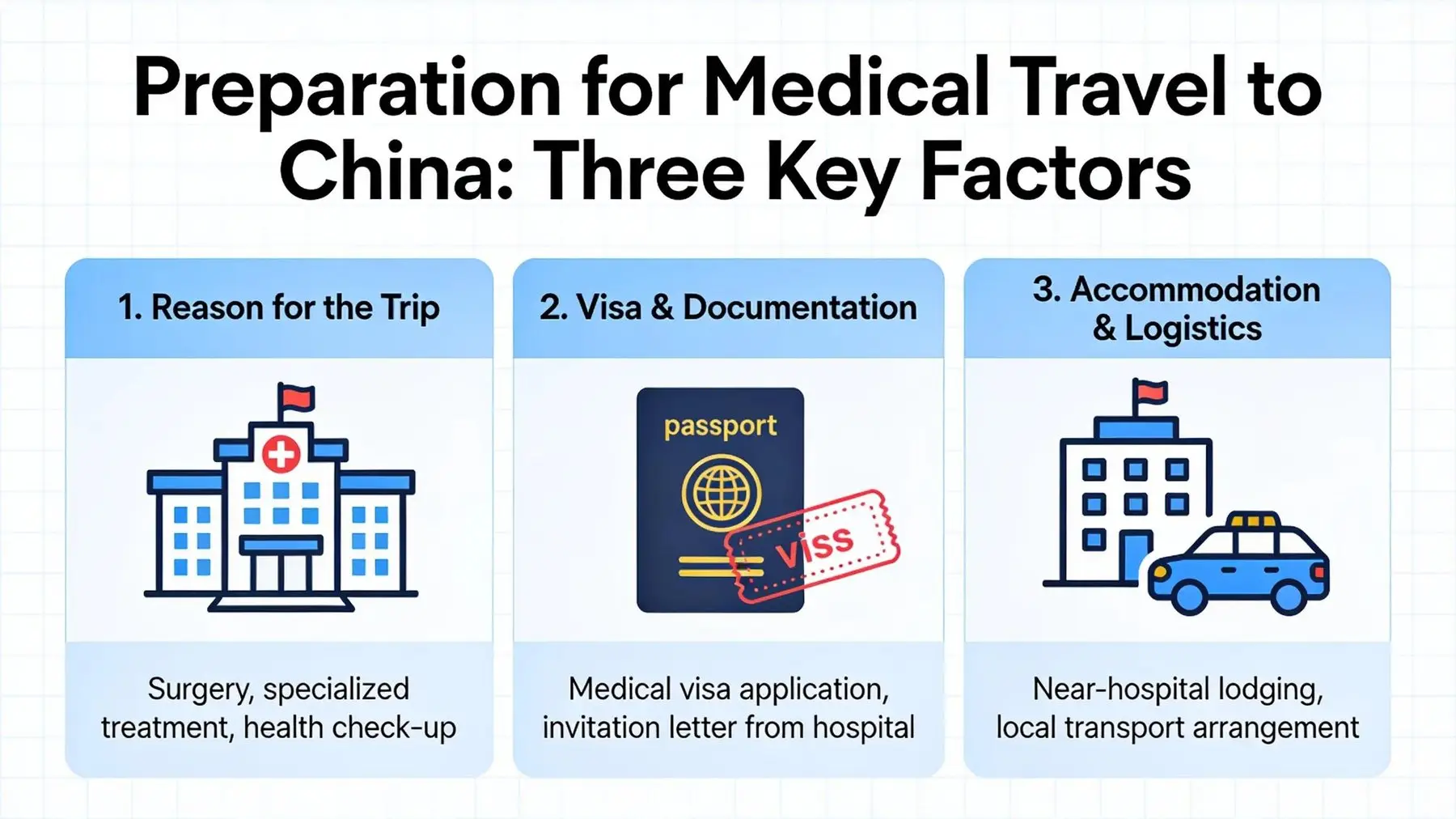
How Do You Search for the Right Hospital?
Finding the right hospital starts with narrowing a massive field. China counted 38,710 hospitals, a number so large that spotting the one suited to a specific diagnosis becomes nearly impossible without a system. Of that total, only 1,876 institutions hold the top Grade III, Class A rating, the classification reserved for the country's most capable facilities. That gap between the full list and the highest-rated tier explains why patients researching medical care in China often feel lost before they even begin comparing departments.
Part of the difficulty comes down to language and access. Strong hospitals publish most of their credentials, specialties, and services in Chinese, scattered across dozens of separate pages rather than one summary. Third-party sites often step into that gap, filling missing details with marketing claims that are hard to verify from abroad. Anyone weighing hospitals in China for foreign patients needs a way to cut through that noise.
What's the fastest way to narrow the list?
A structured search works better than a general online search engine. Patients can look up a hospital by its name, entered in either English or Chinese, or filter results by city or medical specialty. That approach turns a huge field into a short, relevant list within minutes.
Do all hospitals treat international patients the same way?
No. Ratings, published services, and staffing vary widely across China's hospital system. Not every facility has the VIP or international department patients expect. A search built around confirmed facts, rather than assumptions, separates hospitals with genuine international capacity from those without it. That distinction matters most for anyone planning medical travel to China around a specific diagnosis or treatment timeline.
[1]
How Do You Confirm International Patient Services?
Confirmation starts with official documentation, not marketing copy. Hospital websites and government health bureaus publish what a facility actually offers. That published record becomes the baseline for verifying any claim about international care. ChinaMedMap builds its hospital profiles around this principle: each profile lists what a hospital officially states about its international services, alongside anything that remains unconfirmed. That distinction matters, since unverified claims create false expectations about language support, billing, or appointment access.
Ownership structure matters here, too. Most hospital care in China is delivered by public hospitals, and their international and VIP (special-needs) departments work inside the general hospital rather than as separate private chains. Those departments are priced by the market rather than at standard public fees, which is also why VIP departments in Chinese hospitals vary so widely between cities and institutions.
What Does a Hospital Profile Include?
We list only licensed medical institutions whose identity traces to an official source, not a third-party directory. Licence or filing numbers are added to a profile once we have checked them, and profiles we have not yet verified with the hospital say so.
How Are Patients Matched to the Right Department?
Matching draws on a working catalog of more than 700 departments across profiled hospitals, organized by specialty and reviewed by a team member rather than an algorithm alone. Patients describe their diagnosis, symptoms, or treatment history first.
- Describe your diagnosis, symptoms and treatment so far.
- Receive a shortlist of departments matched to that need.
- Review hospital profiles showing confirmed international services.
- Ask follow-up questions before deciding.
This gives patients looking at hospitals in China a documented, traceable path through their options, rather than guesswork drawn from unverified listings.
[1],[7],[8]How Do You Request a Match and Book Care?
Requesting a match begins with a written description of the patient's condition. Anyone pursuing medical care in China as a foreigner starts the process the same way: by explaining the situation clearly before any hospital gets involved.
Before submitting an inquiry, patients should gather three pieces of information. A clear account of the diagnosis or symptoms comes first. Treatment already received comes second. A goal for the visit — whether surgery, a second opinion, or ongoing management — comes third. This groundwork applies whether the patient is seeking routine care as an expat or a specialized procedure planned from abroad.
The steps that follow move in order:
- Describe the diagnosis or symptoms, prior treatment, and desired outcome in the inquiry.
- Submit that description through the matching service.
- Wait for a team member — not an automated system — to reply with providers that may fit the case.
- Review the suggested hospitals, including any with international or VIP departments for added privacy or language support.
- Confirm which option to pursue before records move any further.
What happens after a team member responds?
A staff member reviews every submitted case personally rather than routing it through automated matching alone. This keeps the process suited to complex or unusual medical histories. An algorithm might miss nuance a person would catch.
Is patient information shared with hospitals automatically?
No records or personal details move to a hospital until the patient explicitly agrees to proceed — see our privacy policy. This safeguard protects sensitive medical information while still letting families compare providers. Only after that agreement does the hospital receive anything, keeping the patient in control of the process from inquiry to confirmation.
What Happens During Treatment and What Does It Cost?
Costs and procedures in Chinese hospitals depend entirely on the reason for the visit. Medical care in China for foreigners covers a wide range of scenarios: managing a serious diagnosis, following a chronic condition plan, completing a preventive health check, attending a wellness visit, or handling an urgent issue that arises mid-trip. Each path carries its own timeline, testing sequence, and price range.
A typical hospital visit follows a predictable sequence:
- Register at the international or VIP patient department and present your passport and any prior records.
- Meet with a specialist for an initial consultation and symptom review.
- Pay for and complete the blood tests, imaging, or scans ordered.
- Return with the results for the specialist's review.
- Get a treatment plan, prescription, or referral before leaving the facility.
Why do foreigners choose treatment in China over care back home?
Cost is a major driver. Standard fees at public hospitals are set by the government: in Beijing, the service fee for an outpatient visit at a Grade III hospital is 50 to 100 yuan depending on the doctor's rank, before tests and medicines. International and VIP departments set their own, higher prices. Public hospitals stopped charging outpatient deposits on 31 March 2025; a deposit is still normal before an inpatient admission.
Who decides the final treatment plan and price?
The hospital does, not any matching platform. ChinaMedMap functions as an information and matchmaking resource, connecting patients with licensed hospitals, departments, and doctors. It does not practice medicine, issue medical advice, or guarantee that any hospital will accept a patient or produce a specific outcome. Final diagnosis, treatment decisions, and billed costs rest solely with the treating hospital and its physicians.
[4],[9],[10],[7],[11]What Insurance and Visa Rules Apply to Medical Travel?
Two separate insurance tracks govern healthcare access across China, and neither one was built with visiting patients in mind. Employee insurance covers people in work. Resident insurance covers urban and rural residents without employee cover. Both depend on local employment or residence, not nationality — so foreigners employed in China must join employee insurance and international students must be insured under their school's rules, while patients travelling to China for treatment are not covered.
The scale of the two tracks shows a system built to serve residents first. At the end of 2024, employee insurance enrolled about 379 million people, 29% of everyone covered by basic medical insurance. Resident insurance enrolled about 947 million — 71% of the covered population.
| Insurance Type | Who It Covers | Share of Covered Population |
|---|---|---|
| Employee Insurance | People employed in China, including foreign employees | 29% (379.5 million) |
| Resident Insurance | Urban and rural residents without employee cover | 71% (947.1 million) |
Is there a special medical visa for treatment in China?
No single "medical visa" covers every patient. Travelers seeking international medical care in China normally apply for an S2 visa with the hospital's certificate, and should check with the nearest Chinese embassy or consulate to confirm which visa category fits their situation before booking flights or hospital appointments.
How can patients prepare for the insurance and visa gaps?
Preparation starts before departure, not at the hospital entrance. ChinaMedMap publishes practical guides covering visas and medical records so patients arrive with the right documents already sorted. Confirm visa category, insurance status, and paperwork requirements in that order, well ahead of any consultation, since correcting these gaps after arrival costs both time and money for someone already far from home. Treat insurance and visa checks as the first step, not an afterthought.
[2],[12],[13],[6],[3]What Mistakes Should You Avoid When Planning?
Poor planning derails medical care in China for foreigners more often than the medical condition itself does. Assuming any hospital, department, insurer, or travel route fits every case ranks among the costliest errors a family can make. Healthcare in China for expats varies by city, hospital tier, and language support. A plan built for one patient rarely transfers cleanly to another.
Common planning mistakes include:
- Assuming all hospitals offer the same international services or staff fluency
- Sending a brief symptom description instead of complete diagnostic records
- Booking a VIP department without confirming it handles the patient's specific condition
- Trusting third-party marketing pages instead of a hospital's own official information
- Skipping insurance and route verification before committing to a treatment plan
Why do complete medical records matter before booking an appointment?
A short description rarely tells a hospital enough. Serious diagnoses require full records — prior scans, lab results, physician notes — before staff can confirm whether an appointment or treatment pathway makes sense. Without that documentation, medical travel plans stall at the first review step, costing patients weeks of back-and-forth before treatment even begins.
How can patients verify a hospital's real international services?
Many hospitals publish most operational details in Chinese, spread across scattered pages. Third-party sites often fill those gaps with marketing claims rather than confirmed facts, which misleads patients about what a hospital truly offers. ChinaMedMap compiles hospital profiles from official sources and marks what each hospital has and has not confirmed, giving families a sourced, dated picture instead of a promotional one before they commit to a plan.
Conclusion
Navigating medical care in China as a foreigner comes down to reliable guidance and sourced information, not luck. ChinaMedMap connects international patients with licensed institutions and gives them transparent, sourced information at every step. A medical journey abroad deserves a partner committed to clarity and personalization — one that helps you make informed choices based on your actual needs, not marketing promises.
Frequently Asked Questions
How much does medical treatment in China cost compared to Western countries?
We have not found an official comparison. Standard public fees are set by the government — in Beijing, 50 to 100 yuan for an outpatient visit at a Grade III hospital, before tests and medicines — and the national average outpatient visit cost 361.0 yuan in 2024. International and VIP departments charge higher, market prices. Final pricing always rests with the treating hospital; ChinaMedMap does not set or guarantee treatment costs.[10],[1],[7]
Do foreign patients need travel insurance for medical care in China?
Yes, in practice. China's insurance runs on two tracks — employee insurance (about 379 million people, 29% of the covered population) and resident insurance (about 947 million, 71%) — and both depend on employment or residence in China. Foreigners employed in China must join employee insurance; patients travelling for treatment pay privately or through international coverage. Confirm your insurance before departure.[2],[12],[6]
How long does a typical hospital visit take for foreign patients in China?
It depends on the diagnosis, the department and the hospital. Patients register at the international or VIP department, meet a specialist, complete the tests ordered, then return with results for a treatment plan or referral. Because there is no family-doctor referral step, a first visit can happen soon after booking.[4]
What records should foreign patients bring for medical care in China?
Actual documentation, not a summary written from memory — prior imaging, lab results and physician notes, translated where possible. Hospitals use these records to confirm whether an appointment or treatment pathway makes sense before the patient arrives. Arriving without them risks delays or refusal at intake.
What is a VIP department in a Chinese hospital?
An international or special-needs unit inside a hospital — usually a large public hospital — rather than a separate private chain. These units handle language support, scheduling and privacy differently from general wards and are priced by the market. Services vary widely by city and institution, so confirm that a specific department handles your condition before booking.[7]
Is there a dedicated medical visa for traveling to China for treatment?
No. Treatment is a private-affairs purpose, so patients normally apply for an S2 visa with the hospital's admission or proposed-treatment certificate. Requirements vary by treatment length and nationality; confirm with the Chinese embassy, consulate or visa application center before booking flights.[3]
Does ChinaMedMap guarantee acceptance into a Chinese hospital?
No. ChinaMedMap matches international patients with licensed hospitals, departments and doctors based on the needs they describe, with a team member reviewing every inquiry personally. It does not practice medicine, issue medical advice, or guarantee that any hospital will accept a patient or produce a specific outcome — final diagnosis, treatment decisions and costs rest with the treating hospital.
This guide covers logistics, not medical advice. Rules change — check the dates on the references below and confirm with the hospital, the embassy or the authority named. This page was drafted with AI assistance from the official sources listed and approved for publication by ChinaMedMap. ChinaMedMap is not an emergency service; in mainland China call 120 for an ambulance.
References
- 2024年我国卫生健康事业发展统计公报National Health Commission (reposted on www.gov.cn) · Chinese · dated 2025-12-02 · retrieved 24 September 2026
- 2024年全国医疗保障事业发展统计公报National Healthcare Security Administration · Chinese · dated 2025-07-14 · retrieved 25 September 2026
- Chinese Visa Application Service Center (Medan) — S2 document checklistChinese Visa Application Service Center · Chinese · dated 2025-07-15 · retrieved 21 September 2026
- Shanghai government — Healthcare guide for foreignersShanghai Municipal Government · English · dated 2026-05-26 · retrieved 21 September 2026
- Medical Services - Guangzhou InternationalGuangzhou Municipal People's Government · English · dated 2021-04-12 · retrieved 24 September 2026
- Xinhua report quoting NHC Medical Administration Bureau on international medical servicesXinhua News Agency · Chinese · dated 2026-01-20 · retrieved 21 September 2026
- 发展改革委 卫生计生委 人力资源社会保障部 财政部关于印发推进医疗服务价格改革意见的通知NDRC, NHFPC, MOHRSS, MOF (State Council Gazette) · Chinese · dated 2016-07-01 · retrieved 24 September 2026
- 医疗机构管理条例(2022年修订)State Council of the PRC (text published by the Beijing Municipal People's Government) · Chinese · dated 2022-03-29 · retrieved 24 September 2026
- 京卫医〔2023〕8号 (real-name medical appointments)Beijing Municipal Health Commission · Chinese · dated 2023-01-19 · retrieved 21 September 2026
- 医事服务费收费和报销标准 — 北京市人民政府Beijing Municipal Government · Chinese · dated 2026-04-24 · retrieved 25 September 2026
- 关于规范公立医疗机构预交金管理工作的通知(国卫办财务发〔2025〕5号)General Office of the National Health Commission (gov.cn) · Chinese · dated 2025-03-25 · retrieved 25 September 2026
- 在中国境内就业的外国人参加社会保险暂行办法Ministry of Human Resources and Social Security (gov.cn) · Chinese · dated 2011-10-15 · retrieved 21 September 2026
- 学校招收和培养国际学生管理办法(教育部 外交部 公安部令第42号)Ministry of Education · Chinese · dated 2017-06-02 · retrieved 25 September 2026
Found an error? Tell us.
Need help finding the right hospital?
Tell us what you need. A person on our team reviews every request and replies with providers that may fit. We share your details with a provider only after you agree.
Request International Patient SupportNot an emergency service. In an emergency, call your local emergency number.